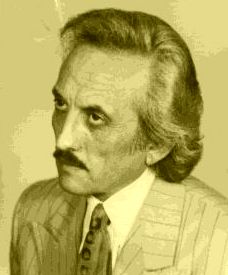
Valentin Marin MESEȘAN
(1949-2002)
- ‘Sălaj – People and Works: a biobibliographic dictionary‘
- Coord.: Florica Pop. Sălaj County Library “I. S. Bădescu”
- Dacia XXI, Cluj-Napoca 2011, ISBN 978-606-604-235-2
- http://www.bjs.ro/Document_Files/Dictionarul%20Biobibliografic/00000032/sukts_DictionarSalaj_OameniSiOpere_BT.pdf
- Page 201
MESEȘAN, Valentin Marin –teacher, poet. B. 14 August 1949, Baica, Hida commune – d. 14 February 2002, Zalău.
Life and career: graduated from the Faculty of Philology in Cluj-Napoca (1972). He was a teacher in Surduc (1972-1973), Racâș (1973-1977), Hida (1977-1978), chief secretary at the Faculty of Medicine in Cluj-Napoca (1978-1991), teacher at the high school in Hida (1991-1992), teacher at the Gheorghe Șincai Normal School in Zalău until 1995, and from 1995 to 2002 he was a teacher at the School of Arts and Crafts in Zalău. He was a member of the Silvania literary circle in Zalău and a regular contributor to the Noesis journal in Cluj-Napoca.
Awards: he won the Duminică publishing house prize at the Lucian Blaga Poetry Festival – Sebeș (1993), the Ion Minulescu Young Poetry and Music Competition – Slatina, 1993.
He contributed to the journals: Caiete Silvane, Silvania, Gazeta de Duminică, Hepehupa (Zalău) etc.
Works: The Seasons of Love (Cluj-Napoca, published by the Forum Cultural Foundation, 1997), The Archive of Silences (Zalău, Silvania, 2002). Collected volumes: The Vertical Flow towards the Sun (Slatina, 1993); Silvania ’90 (Cluj-Napoca, Clusium, 1995), Fehér fekete: Kortárs szilágysági román költõk antológiája / Black and white: Contemporary Sălaj poets, anthology (bilingual volume, Zalău, CCVTCP Sălaj, 1998), Iuliu Suciu — Sălaj poets of the Silvania Circle (Zalău, Silvania, 2008).
- Marcel LUCACIU
- Remember (Valentin Meseșan: 14 August 1949-15 February 2002)
- http://www.caietesilvane.ro/indexcs.php?cmd=articol&idart=1098
Valentin Meseșan
(14 August 1949 – 15 February 2002)
Marcel LUCACIU
‘A haiduc priest’, as Nicolae Fulga used to call him, Valentin Meseșan was born on 14 August 1949, in Hida commune, Sălaj County. He graduated from the Faculty of Philology in Cluj-Napoca, Romanian-French section, class of 1972. He was a teacher in Hida, Surduc, the ‘Gheorghe Șincai’ Normal School and the ‘Voievodul Gelu’ School Complex in Zalău. During the period 1978-1991 he held the position of head secretary of the Faculty of Medicine (Cluj-Napoca).
He debuted with poetry in ‘Tribuna’ magazine; in 1993 he won the ‘Duminica’ Publishing House Prize at the ‘Lucian Blaga’ National Poetry Festival (Sebeș). In 1997, he made his publishing debut with the poetry volume ‘The Seasons of Love‘ (Forum Cultural Foundation, Cluj-Napoca). Posthumously, his volume ‘The Archive of Silences‘ was published (‘Silvania’ Publishing House, Zalău, 2002).
For a decade (1992-2002), ‘The Count’ (as his friends affectionately called him) was the very heart of the county literary circle ‘Silvania’. He departed to the Other Side, embracing ‘the white moment’, on a Friday, 15 February 2002.
Poetry is the most beautiful celebration of the heart, it is a ‘noble uselessness’, it is the sublime rebellion of those who live intensely, loving and hating their own life with equal despair, paradoxically shackled by the nostalgia for absolute freedom.
Among the zealous builders of words was Valentin Meseșan, an authentic talent, irresistible in his brief unbridled expression. I can say that the presence of the man whom everyone called The Count fascinated me every single time. He had a certain elegance, given not only by his mere appearance, but also by the way he knew how to speak to you, to present a book to you, or to tell you his opinion ‘straight to the point’, on any matter. Nothing of what Valentin Meseșan achieved or meant was ever contrived. Because he carried his soul in his palms, in full view of everyone, with a modesty and a good sense rarely encountered.
In the autumn of 1992, when he read – for the first time – a few poems from his troubadour’s bag, I realized that his soul was full of Love, that every verse was full of pathos, that he should have been born in another century (perhaps, the Romantic century). His poems surprised us with their simplicity, their classic clarity and their sunny musicality. I was writing, then, in a literary circle review: “It is a poetry of stylistic volutes, of cascades of incantations that give the impression that we are in the presence of a hymn or an ode (…). Nothing is superfluous here. Every word is a musical note, in a magnificent symphonic poem. But he, he presaged, even back then, the all-too-near ‘white moment’,he foresaw ‘the waxen tears’, signing verses such as these: “Tomorrow my body will be empty and in vain/Like a barren well, a wound of mud/And a bitterly open sky will seek me out/Towards a land with deceptive rains…. “.
Then, for a decade he was a constant presence at the literary club meetings and book launches. In a way, his presence reminded us of Ilie Moromete, for he was often ironic and knew how to joke intelligently. With his poet’s gift, he would detect any awkwardness in a verse, any stylistic negligence or grammatical error.
And yet, when he would descend those evenings, wearing a smile on his lips, his portfolio stuffed with books and manuscripts, his ever-present hat, we would liken him to Pașadia, the character from Craii de Curtea-Veche. And what Mateiu Caragiale wrote about Pașadia Măgureanu fits Valentin Meseșan like a glove: “…he had not been a man of resignation; self-confidence and cold blood had not forsaken him in the darkest moments (…). Like him, no one had known how to wait and endure; unwavering, he had watched fortune at the crossroads, seized it and compelled it to yield what, naturally, was his due, without toil and turmoil (…). He (…) never rose from his work desk among books and papers; he read, wrote without rest (…). What a chosen being, what a difference between him and the others, what an abyss!”. Not long after, I was to learn that Pașadia was his favorite character, and Craii de Curtea-Veche was the book dearest to his soul…
For both the poet and the teacher of the mother tongue, Valentin Meseșan (who often quoted the emblematic verses “It is not death that shakes me, / But its eternity”), life was like a storm in an hourglass, like a candle on the altar of an ‘indecent age’. As painful as an open wound is the fact that we shall no longer be able to discern his face except among the poems in ‘Anotimpurile iubirii‘ and ‘Arhiva cu tăceri‘.
One of Marin Preda’s novels opens with the statement “Death is a simple phenomenon in nature; only people make it terrifying. I speak of natural death, which is often a sweet temptation… ” and closes with the eulogy of the myth of happiness through love: “…as long as these steps I have climbed and descended shall still be climbed and descended by countless others, this book will always testify: if there is no love, there is nothing”.
Wrapped in white shrouds, Valentin Meseșan’s books are also proof of such a love, always fierce, always stronger, always able to move mountains. I cannot bring myself, I do not want to know whether he, the Count, conquered life or, on the contrary, life conquered him. I know, however, that he believed in Love and loved – passionately! – Poetry.
Alongside the countless and beautiful memories, I am left with this unshakable conviction: “Masters of themselves, poets are only born; they never die”.
- (Marcel LUCACIU – Remember
- http://www.caietesilvane.ro/indexcs.php?cmd=articol&idart=1098)
Nicolae Fulga (about Valentin Meseșan) – http://nicupetria.blogspot.ro/2011/06/xvi.html
“So much clarity and so much passion together I have never encountered except in Arghezi, such splendid impudence of the word I have never found since Miron Paraschivescu, and so much folk-style poetry I have not found except in… Valentin Meseșan”…
…the one who “was born under a stormy zodiac sign in full summer, has in his soul something of a haiduk priest, and I believe he falls asleep to the thunder of hooves and dreams of lightning weddings. In his poetry, grass tingles the ankles and lips are scorched by longing, wings return defeated, rains are deceptive and white; what touches the sole, kisses”.
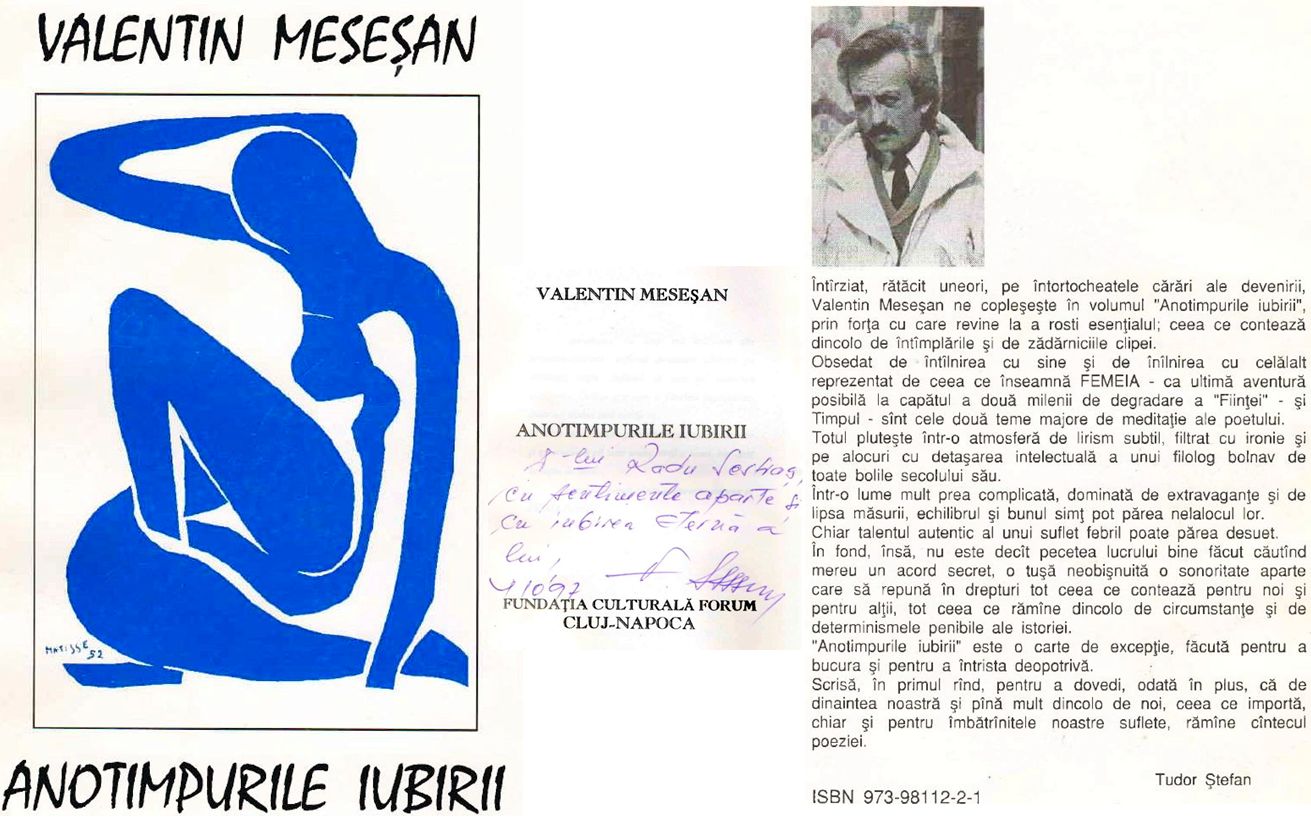
Valentin Meseșan – ‘The Seasons of Love’, 1997
Song for Friends
Once, the paths crumbled beneath us
The saber burned at our waists
From golden cups we drank only vintage wine
And no maidens remained after our eyes…
÷
Unstoppable as water we galloped through the dark
To quench the sin from burning lips
The old town collapsed, complicit in the night
Lovers awaited us with lamps of vanquished mystery…
÷
The shipmates have now scattered home
The saber no longer flashes at the moon
In the grass without poppies, tears burn from the scythe
And in the heart, not even a leaf rings anymore…
÷
And the sick century dulls us
In stripes of clouds, birds of ash grow
A stone sarcophagus from vanquished earth grows
And the tear no longer finds its door to the eyes…
÷
The seconds do not fit in the clocks
And the heart has learned to be silent…
From the golden cups, today all the fools drink
The sabers long ago have rusted in the sheath…
Chant X
When you step into my palm,
I will be for you the bitterness in the grain
that refined lovers taste and sip
or, I will be a seed of lightning and moon
when poisoned whispers gather on the lips…
÷
When you step into my palm,
sip from my soul the blue of a god
and my rough blood, a rainbow spring
and I will be for you an unexpected incantation
or, rains of birds turned into song…
÷
When you step into my palm,
on horses foamed by the road, evening will overcome us
at the inn of chance, summer will flow from the wine
you will kindle with your eyes wars between stars
I will place my heart as a prayer between them…
When you step into my palm,
Sundays with loves will grow in the calendars
And every second will bring forth brides in the world…
Chant XVIII
wait for me, someday I will come
more measured by time and by the iele
in the heart with gold from the desert
and in the hair with the silver of rebellious snows…
÷
and I am late, humbled by so much sin
by night the poisoned eye extinguishes…
I have traveled through stars, but I am not star-studded
and the blue I gathered rots in my blood…
÷
but if you want, wandering stranger
stellar madman, in the hair with the scent of wind
wait for me with the burning full glass
and in the eyes with a light beyond words…
÷
then I will bloom the path beneath your feet
from the too-rich sky I will steal a star for you
in your hair I will place autumn and in the tear a question
and in the heart… as wide as it remained to me.
Song for a Clumsy Butterfly (VIII)
Grass – wonder
Green – cry
High song
The eye’s time…
÷
Bird – wonder
Blue – turning
Budding of the sky
On the heart’s field…
÷
And I,
Second – Rainbow…