Horticulture in Cluj in the Period 2008-2016
Excerpt from the publication:
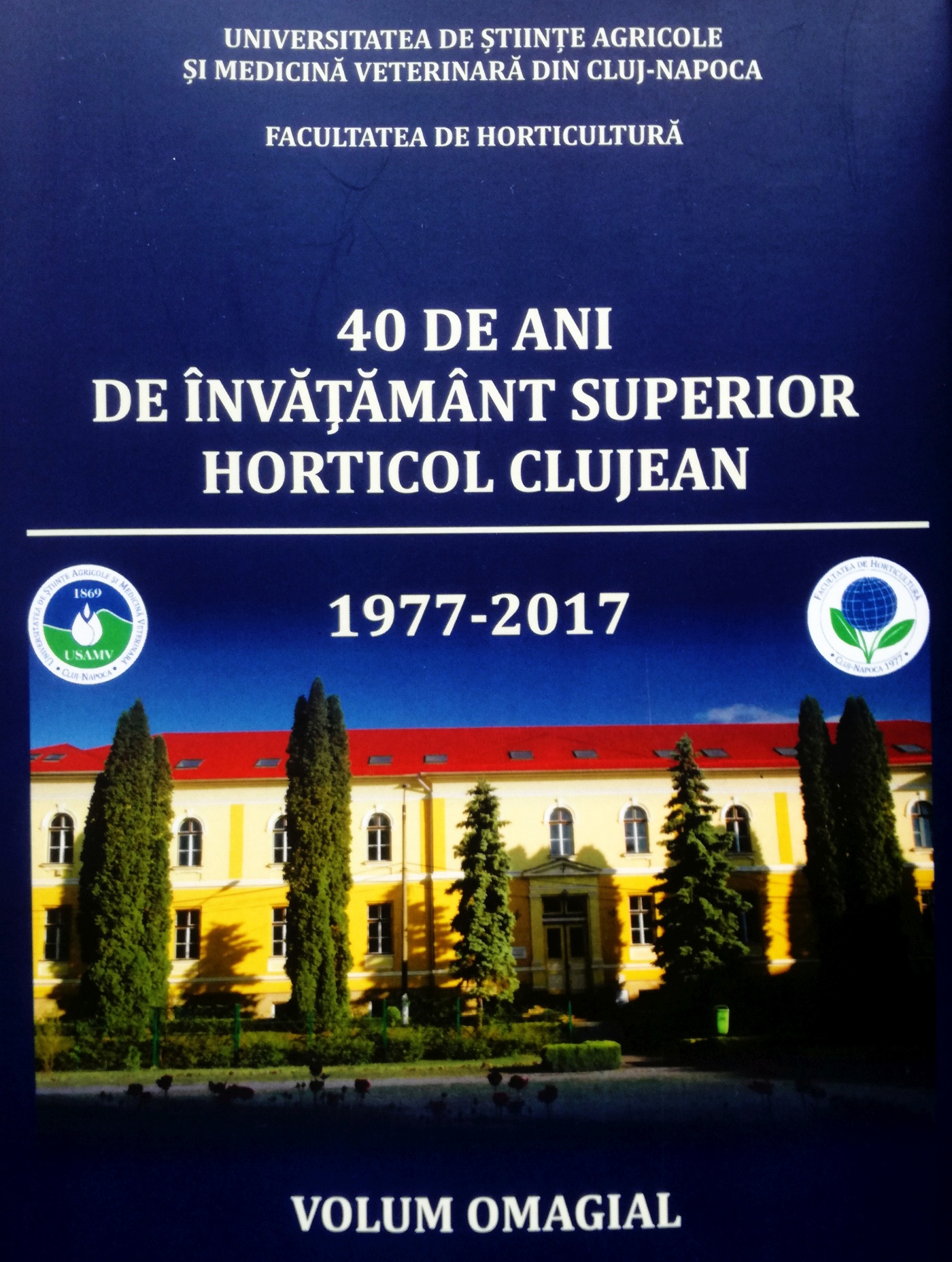
- 40 years of horticultural higher education in Cluj, 1977-2017.
- Commemorative volume (AcademicPres Publishing House, Cluj-Napoca, 2019)
- University of Agricultural Sciences and Veterinary Medicine Cluj-Napoca
- Faculty of Horticulture
- AcademicPres, Cluj-Napoca
- Period 2008-2012; 2012-2016
Horticulture in Cluj in the Period 2008-2016
- Prof. dr. h.c. Radu E. SESTRAȘ
- Dean of the Faculty of Horticulture Cluj-Napoca, in the period 2008-2012; 2012-2016
On the anniversary of the Faculty of Horticulture in Cluj-Napoca (celebrating 40 years!), it is a great pleasure to relive the moments and milestones that constitute the historical landmarks in the development of this wonderful institution.
As a former dean, I recall the period 2008-2016 as one of exceptional fruitfulness in the development of the faculty, in which the efforts of the teaching staff and the faculty personnel materialized in outstanding results and achievements, in a by no means easy stage, in which Romanian higher education was going through a continuous period of ‘searching’ and ‘rediscovery’…
It was the period of authorizations and accreditations/reaccreditations for all the faculty’s study programmes, both at undergraduate and master’s level, a period in which the efforts to fulfil the conditions set by the ‘Bologna Process’ and the commitment to ensure a common framework for European higher education were assiduously continued.
In everything I thought and undertook in my capacity as dean, I had in mind, first and foremost, the students, and what we must offer them, as a higher education institution and as ‘teachers’…, the institutional mission, but also the individual one, of a ‘professor’…, of professional and intellectual formation and training, but also human and spiritual…
These desiderata were discreetly reflected in the numerous regulations and methodological norms elaborated for the evaluation processes, the functioning of the faculty and its departments, curricula, syllabi, the improvement of study and practical conditions, in the restructuring of the faculty into departments and subsequently into divisions that would ensure efficient management of the study programmes…
New departments were created, to ensure good management of the newest study programmes and to streamline the established ones, so that in 2008 the following six departments were functioning within the faculty: Horticulture and Landscaping; Horticultural Technologies; Forestry; Business Administration; Economic Analysis and Management; Land Surveying and Exact Sciences. The undergraduate and master’s programmes were modernized, the human resources were strengthened with new and valuable teaching staff, among the best specialists or graduates… New and ever more results emerged…
Horticulture became the largest faculty in the university, both in terms of the number of admission candidates and the number of students, teaching and non-teaching staff, and self-generated revenues… The new programs, established by the faculty with great effort, but sometimes also with particular difficulties, as mentioned by previous deans, were fully validated through their accreditation… Within the Horticulture Department, the development of ‘Landscape’ involved attracting teaching staff with competences in the relevant speciality subjects and the continuous adaptation of the curriculum towards an increasingly harmonious educational process grounded between ‘plant sciences’ and ‘landscape architecture’. Relatively few years after the not-at-all-easy accreditation of ‘Forestry’, Cluj became one of the important poles of higher forestry education in Romania. There could not have been a more fitting personal and institutional recognition in this regard than the conferral of the title of Doctor Honoris Causa to the Dean of the Faculty of Horticulture in Cluj-Napoca by the most prestigious Romanian university in the field of forestry, Transilvania University of Brașov. Within the Economic Sciences Department, the status of the IEA and IMAPA bachelor’s programs was harmoniously consolidated by the new IMIT program, as well as by the generations of graduates aware of the quality of the training they received during their years at university. A crowning of the continuous efforts to ensure a quality educational process was the accreditation of the ‘Land surveying and cadastre’ specialisation. It was one of the most difficult objectives regarding the faculty’s study programs, proposed as dean, but also as former vice-dean of the faculty. The fulfilment of this desideratum and the joy of success were commensurate…
It can be said that a peak moment in the history of the faculty was the year 2011, with the positioning of USAMV Cluj-Napoca in the first value category, of advanced research and education universities in Romania. The fifth position of USAMV Cluj-Napoca among 12 universities included in this category, in a ranking compiled for the first time in our country, according to European criteria, by an international evaluation body (European University Association), was correlated with a very good ranking of the study programs of the Faculty of Horticulture in Cluj-Napoca. The classification of the study programs in the field of ‘Agronomy, Horticulture, Forestry, Forest Engineering’ of USAMV Cluj-Napoca in the first value category (‘A’, out of five categories) and, moreover, in the first position in this category, conferred on Cluj horticulture not only the status of a consolidated ‘brand’, but also evident advantages through the lens of the places allocated for master’s and doctoral programs in the years that followed.
For the development of scientific research, during the aforementioned period, new collaboration relationships were initiated with universities and specialized research institutions both domestically and abroad. Among the internationally recognized scientific personalities who participated over the years in the scientific events, round tables, or workshops held at the faculty level, a leading figure in the field, Professor Jules Janick (Purdue University, USA), was truly impressed by the study, practical, and research conditions, as well as by the achievements of the students and teaching staff of the Faculty of Horticulture in Cluj-Napoca.
To capitalize on the results of scientific research, efforts to promote the faculty’s journals have also continued. In this regard, personal efforts in the area of scientific publications and editorial activity have been sustained, having been materialized in a previous period by the indexing of the university’s four ‘Bulletins’ in ISI Proceedings (a unique fact, given that the name of a city, ‘Cluj-Napoca,’ is repeated in the database ISI-MJL…). The ISI indexing of these was also reflected in a wide international participation in the USAMV symposia, in a period when in Romania little was known about ISI journals… Subsequently, the ISI publications in the Bulletins have been extremely beneficial in terms of scores and performance indicators, as well as for facilitating the competitive appointment of teaching positions by USAMV Cluj-Napoca teaching staff, and others… As editor-in-chief, in 2008 I had the great satisfaction of the indexing of the journal Notulae Botanicae Horti Agrobotanici Cluj-Napoca (http://notulaebotanicae.ro) in ISI (now Clarivate Analytics), Science Citation Index Expanded (Web of Science), in the field of “Plant Sciences”. The quality of the journal was also confirmed by Scopus (Elsevier) indexing in the field of “Horticulture”, as well as in other prestigious academic databases… The journal brings important benefits both in terms of increasing the university’s international visibility and recognition (with beneficial effects also in rankings, e.g. SCImago etc.), and financial ones, through publication fees which represent own income for the university.
In conclusion, I must add two of the greatest desiderata from the reference period 2008–2016, in my capacity as dean of this faculty. Both were also long-term visions, in the hope, but also the conviction, that they would serve the faculty, the university, the teaching staff and the students, the generations to come… But also in favour of the scientific community, of the development of education and research in the field of horticulture in our country, of increasing their efficiency, relevance and visibility in the context of an increasingly ‘globalised’ world…
The first refers to the Horticultural Research Station in Cluj-Napoca (Cluj Fruit Growing Research and Development Station), the place where I had so many professional satisfactions as a scientific researcher… After moving into teaching, I suffered greatly seeing how an elite unit of Romanian research was continuously degrading, with biological material of inestimable value, created by generations of passionate and dedicated researchers, being lost, as the technical-material base and especially the human resource were being lost… I considered that the only way of salvation was its transfer to the university, and the efforts I made in this regard were extremely numerous and prolonged…
The second desideratum refers to the Advanced Horticultural Research Institute of Transylvania (ICHAT), an extremely complex and difficult project, completed over a period of seven years (2009–2016). I was involved as a member in this project, taking on this responsibility as dean of the faculty, with the certainty that the new building, modern, with spacious, bright rooms, with state-of-the-art laboratory apparatus and equipment, with the facilities of the new greenhouses, orchard and vineyard plantations, the gene bank, etc., would mean a great deal for the future of the Faculty of Horticulture in Cluj-Napoca…
I had the pleasure of seeing both objectives achieved immediately after the end of my second term, and I am extremely grateful to those who contributed decisively to their fulfilment… I consider that these achievements are truly historic for the Faculty of Horticulture in Cluj-Napoca, and will represent a new reference point in its future development.
The history of the eight-year term (2008–2016), ‘seen’ from a personal perspective, is a beautiful one, in which the briefly presented results conceal the days and nights of work, the Saturdays and Sundays, the vacations sacrificed to fulfill objectives or aspirations, the efforts, emotions, and energies expended over time, the involvement in an extremely large number of diverse activities for the benefit of the institution and the community. Taking on other responsibilities that I considered indispensable for the proper functioning of the faculty and understanding the mechanisms through which top-quality education and excellence in the professional training of students and scientific research can be ensured, ARACIS missions, CNATDCU, RNE, etc.… But also the joy and immense satisfaction of seeing students and graduates capable of achieving professional, intellectual, social, family, and spiritual fulfillment… The joy of having the opportunity to meet and work with extraordinary people, from home or abroad. The joy of having, in everything that was accomplished in the faculty during these years, exceptional people, dedicated to the institution and the students, both at the university leadership level (rector, prorectors, deans of the other faculties, etc.) and at the faculty level (prodeans, scientific secretaries, heads of departments or department directors, colleagues – teaching or non-teaching staff, administrative personnel, etc.).
I can say that I have the professional satisfaction and the conviction that through the administrative position I held and through the contribution I made to the development of the faculty, I continued the efforts and achievements of some of my predecessors, some of whom have passed into eternity, but who will certainly remain as luminous figures in the history of this faculty. I also hope that I continued their visionary work as educators, school builders, or mentors, as role models for students, for the generations of graduates, and for all who come after…
- Prof. dr. h.c. Radu E. SESTRAȘ (excerpt from ‘Messages from Former Deans‘, the work ‘40 Years of Horticultural Higher Education in Cluj, 1977–2017, Commemorative Volume‘; anniversary event, 26–27 Sept. 2017)