Event – April 24, 2015 – “Transilvania” University of Brașov
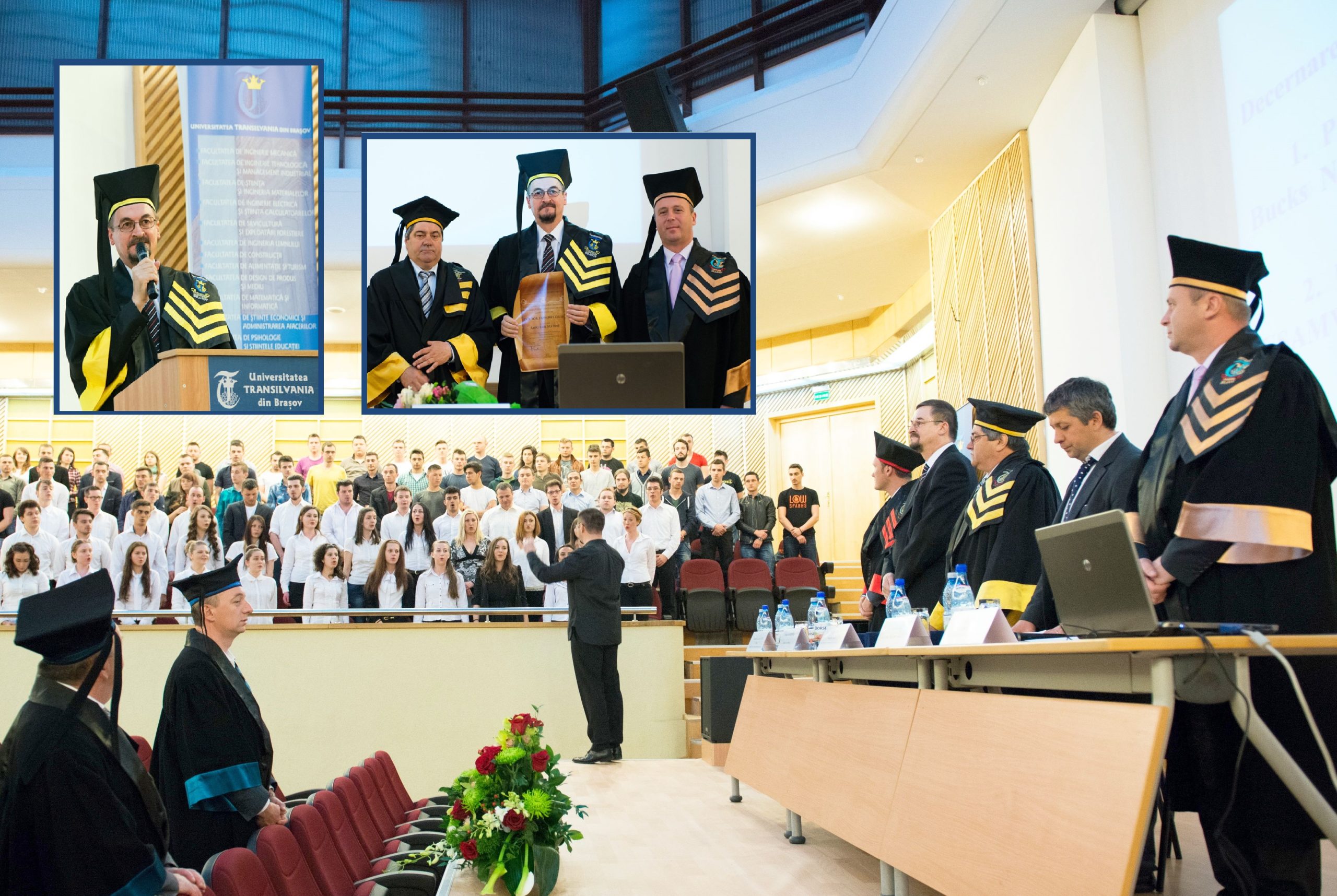
The conferral of the title of ‘Doctor Honoris Causa’ upon Prof. dr. Radu E. Sestraș, Dean of the Faculty of Horticulture in Cluj-Napoca, Honorary President of SHST, by “Transilvania” University of Brașov
At the Festive Senate of Transilvania University of Brașov, of 24 April 2015, held in the ‘Sergiu T. Chiriacescu’ Auditorium, Prof. univ. dr. Radu E. SESTRAȘ, Dean of the Faculty of Horticulture at USAMV Cluj-Napoca, was awarded the title of ‘Doctor Honoris Causa‘ of Transilvania University.
The conferral of the high honorary title took place after the presentation of the “Laudatio” by Prof. univ. dr. Ioan Vasile ABRUDAN, Rector of “Transilvania” University of Brașov and the presentation of the laureate’s activities by Prof. univ. dr. Lucian CURTU, Dean of the Faculty of Silviculture and Forest Management in Brașov and Prof. univ. dr. Neculae ȘOFLETEA, Head of the Department of Silviculture. The Doctor Honoris Causa diploma was handed over by the President of the Senate, Prof. univ. dr. Emil STOICA.
At the same event, the prestigious title of ‘Doctor Honoris Causa‘ was also conferred upon Prof. univ. dr. Ioan Florin IORAȘ, Director of the Institute for Conservation, Rehabilitation and Innovation, at Buckinghamshire New University in the United Kingdom, a prominent scientific personality internationally in the field, born in Brașov, and a graduate of “Transilvania” University.
Brief biography
Radu E. SESTRAȘ (born on June 3, 1961, in Hida, Sălaj County). Graduated from the Faculty of Agriculture and Horticulture in Cluj-Napoca (1985); PhD in Plant Genetics and Breeding (1997). Scientific researcher at the Cluj-Napoca Research and Development Station for Pomology (1990-1994); since 1994 academic staff at the University of Agricultural Sciences and Veterinary Medicine Cluj-Napoca, courses taught: Plant Breeding, Biostatistics and Experimental Techniques; full professor, PhD supervisor; vice-dean (2004-2008) and dean (2008-2012; 2012-) of the Faculty of Horticulture in Cluj-Napoca. Author or co-author of 15 books or chapters in specialized books and of over 250 scientific papers published in Romania and abroad. First author or co-author of 21 newly registered varieties, nine apple and twelve pear. Member of scientific and professional societies and associations: International Society for Horticultural Science (ISHS), European Association for Research on Plant Breeding (Eucarpia), Romanian Society of Horticulturists (SRH), honorary president of the Society of Horticulture and Forestry of Transylvania (SHST) etc. Associate member of the Academy of Agricultural and Forestry Sciences “Gheorghe Ionescu-Șișești” (ASAS), member of the “Agricultural, Forestry and Veterinary Sciences” committee – Romanian Agency for Quality Assurance in Higher Education (ARACIS), vice-president and member of the “Plant and Animal Resources Engineering” committee – National Council for the Attestation of University Degrees, Diplomas and Certificates (CNATDCU), RNE expert evaluator. Diplomas and medals of professional and academic recognition (e.g. Diploma “Socio Onorario” – Honorary Member – elected, La Società di Medicina e Scienze Naturali dell’ Universita di Parma, Italy, 2005; Medal “G. Rudi“, awarded by the Senate of the State Agricultural University of Moldova, Chișinău, 2007 etc.). Editor-in-chief and referee for AcademicPres Publishing House Cluj-Napoca and for the journals “Bulletin of University of Agricultural Sciences and Veterinary Medicine Cluj-Napoca” (with four series: Agriculture, Horticulture, Animal Breeding and Biotechnologies, Veterinary Medicine), during the period 2000-2012. Referee/editorial board member: “Agricultura – Revistă de știință și practică agricolă”, “Știința agricolă”; “LJS – Leonardo Journal of Sciences”, “Leonardo Electronic Journal of Practices and Technologies”, “South-Western Journal of Horticulture Biology and Environment”, “Frontiers in Crop Science and Horticulture” etc.; editor-in-chief of the journal “Notulae Botanicae Horti Agrobotanici Cluj-Napoca“; founder and editor-in-chief of the journal “Notulae Scientia Biologicae”. http://www.sestras.ro/
Speech by Prof. Dr. Radu E. SESTRAȘ, on the occasion of receiving the title of ‘Doctor Honoris Causa‘, from Transilvania University of Brașov, April 24, 2015
Dear Rector,
Dear President of the Senate,
Dear members of the Board of Administration and the Senate,
Dear academic staff, dear students, dear guests,
If the solemn moment of conferring the title of ‘Doctor Honoris Causa’ is a special occasion for a university, for the recipient it is truly a once-in-a-lifetime event. I am living such a moment today, here, alongside you, and I can only thank you for the sense of uniqueness of this moment that you are offering me in this university, so beautiful, just like its name: Transylvania!
These are overwhelming moments for me, in which the immense honour of becoming a member of the academic community of Transylvania University of Brașov is combined with the soulful and spiritual joy of rediscovering aspirations at the highest level, in this magnificent academic institution.
The very high and prestigious distinction of today is overwhelming, and all the more precious because it comes from a university for which I hold special regard, with representatives for whom I have special feelings and deep respect. Your appreciation delights, honours, and overwhelms me just as much as the title with which you reward my modest contribution in the field of academic education and scientific research.
The chosen celebration that you are offering me today is also an occasion for personal, existential retrospection and for taking stock of a professional, scientific, administrative, editorial, and ultimately spiritual activity, in the context of this exceptional moment, situated however at the end of three decades of constant personal struggles and searches, insignificantly interwoven in the turmoil of life in Romanian higher education and scientific research of this period.
So that my discourse on these ‘searches’ does not appear too rigorous within the framework of today’s solemn event, I have structured my address in a romanticised style, in a few chapters, of which the last is dedicated to the mission of the ‘school’ and the ‘teacher’. In my presentation, ‘searches’, ‘school’, ‘teacher’ are terms written in quotation marks, and such quotation marks, as well as ellipses, appear in many other places… I hope you will understand and consider them as such, even if you do not see them…
Chapter I
‘The Return’
I have titled this chapter ‘The Return’, because today I can say that I am coming ‘home’. To Brașov, a superb city that I have always loved and where I chose my work assignment thirty years ago, upon graduating from university. Later, I gave up the ‘double’ assignment, and instead of the Brașov Grassland Research Institute, I chose the Cluj Horticultural Research Station. Yet, I have remained, forever, with the nostalgia for Brașov… I have continually found the same feeling and nostalgia on the part of all forestry engineers from Transylvania and from across the country, as well as from my colleagues in Cluj, in the Department of Forestry. I have always fully understood their pride in being graduates of this university and of the renowned Faculty of Forestry in Brașov. From today, I will have the same pride and beautiful feeling, but also the awareness and responsibilities that come with belonging to ‘Transilvania’ University and, respectively, the Faculty of Forestry and Forest Management in Brașov.
Chapter II
‘Notions of … genetics?’
The desire to ‘know’, to ‘learn’, to ‘study’, to ‘experiment’ are internal factors in the individual development of the scientist, constituting the driving force behind professional and intellectual formation. In genetics, the phenotype (the set of characteristics and traits of an organism) is the resultant of the genotype (the genetic endowment of an organism), the ecotype (the totality of environmental factors in which a given genetic background is expressed), and the interaction between genotype and ecotype.
For humans, the ‘ecotype’ includes, as an environment for intellectual and spiritual formation, the family, the school, the learning and development environment for intelligence. What an exceptional chance to have such a favorable environment! What a chance to have someone to learn from! In an uplifting moment such as the present one, it is a moral duty for me to think with gratitude of my predecessors, who offered me this chance!
For years, I have recalled the courses of the renowned professor of ‘Genetics’, Costică Panfil… “Every human being is formed and develops from an initial cell, the ovum or zygote. It brings together the ‘endowment’ of the two parents in a new genetic configuration, a ‘unique constellation of genes’… Man is the product, the resultant of the permanent interaction between the two ‘forces’, heredity and environment, which condition the totality of his vital structures and functions…”.
I remember the beneficial effect that Professor Panfil had on me, when I was his student and then PhD candidate, impressed by his status and his reputation as a top genetician in Romania of those times. After the years of doctoral studies came the transition from research to teaching, the years in which, as an assistant and then a senior lecturer, I worked, I learned, I was formed in the same university space in which the professor had been active. The professor’s ‘space’ obliged me, but also inspired me. It could not have been otherwise; Cluj had become a recognized center in plant genetics and breeding in Romania. The recognition and eminence of the geneticist Panfil grew along with the school formed by the great professor. Mircea Savatti, Marin Ardelean, Constantin Botez became very well-known and respected professors in the field of plant genetics and breeding. They, in turn, became formers and creators…
Chapter III
‘A quarter of a century of searches in higher education and scientific research in Romania’
Please disregard the extremely pretentious title of this chapter; in reality, it is merely a presentation of personal, eclectic views on the idea to which the title refers.
*
Subchapter III.1. – “The Tyranny of the Impact Factor”: the international context
…Guided by the same factors I mentioned as the ‘spring’ of personal formation, the desire to ‘know’ and ‘learn’, combined with a certain curiosity and desire to ‘experiment’, I dedicated my time and energies not only to preparing and delivering teaching and research activities, but also to an activity in which I rediscovered pleasure and passion: the editorial one. In fact, in this case as well, the ‘genotype’ found the favorable ‘environment’ in which to manifest, represented by the journalistic activities at the university, and the ‘interaction’ with the professor and dean Marin Ardelean, the editor of the university’s ‘Buletinul’, the main scientific journal at that time in our institution.
I began systematic work at journals keeping in mind not only their scientific ‘mission’, but also their role and the importance highlighted ‘pragmatically’ in the so-called ‘rankings’ / international classifications of universities and research institutions. I realized that among the criteria considered by the various bodies that produce such ‘rankings’, including the well-known ‘ARWU’ (‘Academic Ranking of World Universities‘ or ‘Shanghai Ranking‘), some are inaccessible to us: teaching staff or alumni who are laureates of the Nobel Prize or Fields Medal, the most cited researchers in scientific reference categories, papers published in ‘Nature‘ and ‘Science‘ etc. I realized that among the few criteria in which we have the possibility to accumulate points, there are papers indexed in ISI Web of Science. I became aware not only of the importance of having ISI-indexed publications, but especially of owning such publications… Our time and efforts to improve the scientific quality and visibility of the university’s publications materialized in the early 2000s with the indexing of the four ‘Bulletine‘ in the prestigious ISI academic database. Subsequently, due to the exponential growth in the number of articles and the impossibility of maintaining a rigorous editorial process, the four journals were no longer indexed (no one ‘suffered’ too much, because at the time ‘ISI’ was hardly known…). My struggles and searches gave me the experience and the ability to understand the phenomenon… I realized the scale and complexity of the publishing process and the international interest in scientific publications, based primarily on colossal annual sums allocated worldwide to research and technology transfer, but also on the policies of the major ‘publishers’… I became aware of how much subjectivity can arise in this field, which is nevertheless, at a global level, centered on certain institutional and financial interests and policies. I understood the frustration of Professor Jules Janick, from Purdue University, USA, a true “sacred cow” of world horticulture and scientific publishing in the field, when he wrote “Tirania Factorului de Impact“. In the article, Prof. Janick compared the injustice by which a private institution (ISI Thomson Reuters) arrogates to itself the status of ‘world gendarme‘ in the scientific world, by not indexing the most well-known publication in the field (‘Acta Horticulturae‘), with that done to Gregor Mendel, whose research was not recognized in value, being reviled even by the representatives of the church in which he worked… Later, after his death, the validity of Gregor Mendel’s work was recognized, and he was called “Father of Genetics”…
I also realized the ‘substrate’ of the struggle in the field of scientific publications, and the international context of interests in science: national, international, geostrategic, political… Visibility, credibility, recognition… Power, funding, hegemony… The ‘madness’ of ISI migrated from Western countries to the whole world… It was inevitable that it would reach Romania as well… In international ‘rankings,’ positions change… New ‘powers,’ new ‘worlds’ appear. China confirms its increasingly solid status, in South America Brazil becomes an increasingly strong force, and the Arab world gains more and more ground with a seemingly directed policy, ‘cited’ or ‘self-cited’… India and Pakistan are not just countries with a large population and nuclear powers… Massive investments in education and science/research bring Islamic countries increasingly better positions in the top rankings, countries such as Iran and Turkey climbing in these rankings in a seemingly unbelievable way in recent years…
… The criticisms and polemics surrounding ISI – WoS – Journal Citation Reports (JCR), as well as the editorial giants with hundreds and thousands of journals indexed in ISI (e.g. Elsevier, Springer, Taylor & Francis, Wiley, Blackwell, Sage, etc.) never seem to end… Jaime A. Teixeira da Silva’s fight with the giant Elsevier, the accusations and mutual declarations of hostility (from da Silva’s allegations of involvement in the arms industry directed at Elsevier, to the declaration of the controversial figure as “persona non grata” by one of the most reputable journals, paradoxically followed by the ‘on-line first’ publication this month of a review by the same author), creates disputes and opposing camps on the ‘Retraction Watch’ website (http://retractionwatch.com). The indefatigable Jeffrey Beall wages an unceasing battle against ‘predatory’ journals and ‘publishers’, and his list (http://scholarlyoa.com) of ‘prey’ open-access journals, pirated, ‘cloned’, etc., or ‘organisations’ that take it upon themselves to calculate ISI-type ‘impact factors’, continues to grow… Worldwide, and at home as well, the vortex draws in various publications and honest individuals, along with some who have nothing to do with scientific ethics or editorial professionalism…
But, despite all this, the ‘system’ is a dynamic one, with the capacity for continuous ‘self-cleansing’, and the ‘concept’ of ‘Publish or Perish‘, transformed from the individual/researcher level to the publication level, becomes ‘Keep up, or perish!‘… and leads to the disappearance or marginalisation of weak or under-resourced publications. In parallel, the truly ‘strong’ journals, especially those of the aforementioned giants, or some newer ones from ‘conglomerates’ such as Frontiers and Nature Publishing Group, are developing increasingly performant and sophisticated systems, platforms, and editorial boards, and are becoming ever more selective, costly, and elevated in the scientific world.
*
Subchapter III.2. – “ The Tyranny of the Impact Factor ”: the national context
What was to be expected, happened! The ISI ‘madness’ penetrated into Romania a few years ago! It caught us completely unprepared, exposed, and vulnerable, so the shock was total! The various opinions on this subject, ‘from the top down’ (ministry – universities / research institutes, and conversely ‘from the bottom up’), were understandable, given the situation of continuous uncertainty since 1989 in the Romanian academic system, the difficulties faced by universities and research institutes, the lack of political consensus in education and research, the inconsistency, incoherence, lack of coherence and long-term security of normative acts and regulations in the field, the securing of funding, of doctoral scholarships, the respect of contractual clauses, etc.
It was inevitable that the discussions and opinions related to academic evaluation would extend to national councils, agencies, or academies… CNATDCU, ARACIS, ASAS… Bodies composed of people with diverse opinions, sometimes totally opposed… Shortly after a CNATDCU session in which the majority of members, performing well in terms of scientific results and visibility, supported new standards for scientific evaluation, respectively criteria for certification and the awarding of scientific titles (ISI and SRI publications and citations, etc.), which seemed inaccessible, I attended one that was completely the opposite. Even though it took place in the highest academic body for agricultural and forestry sciences in Romania (ASAS), I was surprised to see the enormous difference in thinking, concept, and vision of the participants, completely opposite to that of the previous meeting… A hostility and total rejection of ISI, supported by the laithmotif that “we do research for Romania…”. Later, I was no longer surprised by the ANELIS statistics, in which the total number of accesses to the ISI WoS database by ASAS had been, over an entire year, 39… I left with a rather confused feeling, just as after the previous meeting, but additionally with an indescribable bitterness… How will the Romanian academic system clean itself up and evolve? How will it find its balance, the strength to move forward?… The answer is, however, so simple… Through valuable people, of balance and vision, with professional and moral integrity, willing to dedicate their energies to this purpose…
*
Certainly, high-performing research, evidenced by publications of commensurate quality, cannot be achieved overnight and without adequate resources. On the other hand, the results of research and their value must be evaluated/confirmed on the basis of quantifiable indicators, and ISI Thomson Reuters remains the reference system in the entire scientific community, so it is perfectly justified to accept it and take it as a benchmark. Obviously, the fact that many PhD supervisors, or teaching staff and researchers with experience in teaching and research activities, some with notable results, do not have the same results in terms of ISI publications, cannot constitute an accusation against them. Let us not forget that until a few years ago, few knew about ISI, or the importance of ISI publications, or of other academic databases. But things evolve, time passes, and we must think about the new generations…
A few years ago, in England, I was struck by the fact that in certain courses, students learned how to present themselves on the phone, how to use various tree-climbing techniques in forestry, or how to write an article… Have we gone through such stages? Have we learned how to write an ISI article? Do we even now, in our undergraduate, master’s, and doctoral programs, have notions regarding the valorization of research results through the lens of academic publications? The principles and methodology of scientific research, included pragmatically and in a relevant sequence in programs, can offer systematic foundations for ensuring success in this regard. But the premises are merely theoretical, pertaining to the formation of human resources, because, ultimately, success depends directly on concrete resources represented by the technical-material base, apparatus, equipment, consumables, but also continuous professional training, international integration, and numerous other resources… We come back to the ‘vulnerabilities’ at the beginning of the subchapter, and to the need for a coherent, long-term, predictable national policy…
*
I thanked you at the beginning of the lecture for the high honor you are bestowing upon me. I said it comes from an institution for which I hold special esteem, with representatives for whom I have particular feelings and profound respect. The days, nights, and vacations spent working in the realm of science have flown by… The fact that when questions or requests were sent in the middle of the night, on professional matters or reviews of various scientific works, I would immediately receive an email response from a collaborator (sometimes even the rector, dean, or in other administrative positions or responsibilities, sometimes personalities recognized at the highest level in the scientific field and of personal, institutional, national, and international representativeness…) certified the usefulness and importance of my work, and made me believe that I was doing nothing more special than others. That I merely had an equally busy, or ‘dedicated’ schedule…
Today’s moment pulls me out of my reverie! It comes from such a university, with such people! Surely, my effort was far too small for such recognition! But what a soul-fulfilling joy is your appreciation, what a sense of completeness is sharing common ideals and aspirations with people whom I respect, admire, and value! Of whom I am convinced they have the power, intelligence, and honesty to find the resources in Romanian education through which hope returns that the ancestral wellspring of values is not dried up and that we can move forward…
Chapter IV
‘Rediscovery?’
Year after year I have tried to educate, shape, and raise the awareness of my students so that they become not only engineers, good specialists in their field, but also true human beings and intellectuals, who validate themselves professionally, socially, and spiritually. People who succeed through their own strength, personality, and character, but through hard work and assiduous dedication, seriousness, perseverance, correctness, and honesty. This is a desideratum that I have pursued and which I hope to instill in my students as long as I remain at the lectern… A desideratum centered on the three great values of spirituality, as formulated by the renowned British writer William Somerset Maugham in a reference work, ‘The Summing Up’ (‘Balance’): ‘Truth’, ‘Beauty‘ and ‘Goodness’. I believe these are key values of humanity, universal, which should be reconsidered now more than ever, at a moment in humanity when the moral values of society and the inner balance of each person are strongly upset by the tumult of a frenetic life, in which we forget that our ‘passage’ is so ephemeral… How beautifully Somerset Maugham captured this ‘passage’…: “The great tragedy of life is not that people lose, but that they cease to love…”. Maugham’s three universal values (‘Truth’, ‘Beauty‘ and ‘Goodness’) are sublime… Once penetrated, understood, and assimilated, they offer you an unimagined comfort: the acceptance of life, of things, of differences in thought, opinion, concepts of life, religion, culture, and art, of your ‘mission’ and role in life, of the responsibility you have towards your own being, family, society, spirituality…
In the autumn of last year, in Cluj, in the ‘Aula Magna’ of our university, I was a witness to a rare moment in which I rediscovered the strength of the three values materialized in a short speech by a faculty member whom we were celebrating, and which expressed a true philosophy of life. The event was dedicated to the 100th birthday of Professor Vasile Nilca; the professor had an extraordinary life, full like the century he lived through, but with numerous moments of crisis. At one point, for political reasons, he was removed from the lectern. He remained to the end an optimist, grateful and at the same time aware of what he would have wished and managed to do in life. He gave a memorable speech, so I was glad to have had the privilege of listening to it, hoping that the students and my younger colleagues present in the Hall would understand it too. Here is a short excerpt: “It is a unique moment in my life. During the speeches of those who took the floor, it was as if the film ‘The years have passed like long clouds over the plains’ was unrolled before me. Indeed, many years have passed since in this hall, in 1939, the erudite Professor Grăniceanu declared me a graduate of the Academy of Higher Agricultural Studies Cluj… The greatest satisfactions I have obtained were at the lectern, in this atmosphere of high academic standing, in which I managed, to the extent of the possibilities I had, to be a teacher giving advice and to be in the service of those who expected knowledge from me…”.
*
I was impressed by the fact that a university professor, upon reaching the age of 100, remembered with respect, indeed with veneration, his erudite professor, from whom he had the honor of receiving his engineering diploma. I was deeply impressed by his dedication as a ‘teacher’, by his understanding and respect for the mission he had undertaken, that of teaching and educating students…
What a feeling of fullness it is, in which, in those special moments, given by the joy of a professional or spiritual achievement or fulfilment (‘summing up‘ / summary…) you remember your professors, those who educated and shaped you, who contributed to your intellectual and spiritual ‘refinement’…
In the end, I can only thank you again for the immense honor you have done me today, wish you to be aware of your own “constellation of genes” and the unique one you work with, model and shape, and always keep in mind, in everything you do, those three supreme values of spirituality: ‘Truth’, ‘Beauty’ and ‘Goodness’.
Thank you!
Prof. dr. Radu E. SESTRAȘ
24 April 2015