(The thoughts of a friend and his modest tribute to Professor Gică GRĂDINARIU)
Prof. dr. Gică GRĂDINARIU – friend, MAN, creator and shaper of the school
For years on end I have travelled the road from Cluj to Iași, with the desire and eagerness to reunite with my dear and great friend, Professor Gică Grădinariu, the renowned dean of Iași horticulture…
When did I first meet him? How did we grow close? How did he become one of the dearest people in my life? How did I have the feeling that I had known him and we had been friends all along? It is interesting that Adriana, my wife, had the same feelings about him from the very beginning.
How poor life is without such a friend… And yet, how beautiful life is with just the reverie, with the beautiful memory of such a man, of the moments spent together, of the discussions and sharing of ideas, thoughts, aspirations, fulfilments…, or of ‘what is to come‘…
How right Jorge Luis Borges was:
With time you realize that although you can be happy with your friends, one day you will weep for those you let go.
With time you realize that every experience lived alongside every being will never be repeated.
With time you realize that in reality, the best was not the future, but the moment you were living in that very instant.
With time you will see that although you feel happy with those around you, you will terribly miss those who were with you just yesterday and have now gone and are no more…“.
Why do we realize these truths so late, only ‘After a certain time‘…? When did Jorge Luis Borges realize it? And me? And Professor Grădinariu?… I am sure he knew them all along… I am sure he never needed to learn them… Because those truths were in his nature. In his mind, in his spirit, in his way of being, of behaving towards those around him… A mind, a spirit, a ‘way of being’, specific to great, chosen, elevated people… To those who are predestined…
Professor Gică Grădinariu was such a MAN… A man who, clearly, left the person beside him with the feeling of experiencing something unique, unrepeatable… A man who knew that, in reality, the best is not the future, but the moment lived in that very instant… And he lived intensely every moment, with his whole being, without the fear of exhaustion or ‘what is to come‘… With love, kindness, generosity, intelligence, dedication, hard work, passion, beauty… How else could he become one of the most well-known, most valuable, most recognized university professors? Recognized in Romanian pomology as a specialist of the greatest caliber, but also a professor from the category of ‘symbolic teachers’ who remain immortal in the consciousness of the generations of pupils and students he trained. A professor who loved, supported, and unconditionally promoted Romanian horticulture, merging himself with it, who left his mark on its history in recent decades, trying to break through to the light through the labyrinth of bureaucracy, the ‘system’, the ‘structures’, the groundlessness of the times, dilettantism, insincerity, and the hypocrisy of some… A man who dedicated himself to his profession, to work, always willing to sacrifice his energy, time, and health to contribute to science, research, the progress of knowledge in horticulture, academic development, the training and education of generations of young people, both professionally and intellectually and spiritually… The Faculty, the University, and academic Iași could not have had a better representative…’
Professor Gică Grădinariu’s name seemed almost predestined for horticulture… Through him, Iași horticulture offered Romanian horticulture a luminous figure, who will remain inscribed in the gallery of great scientists of our country. How fondly I called him ‘Dean of Romanian Horticulture,’ ‘Dean of Deans,’ or ‘The Platinum Dean’… With how much friendship, admiration, and respect these titles were accepted by all the leading representatives of the academic community in the field across the country… As dean, Professor Grădinariu managed not only to build an exceptional image of the Faculty of Horticulture in Iași, but also to forge professional, scientific, but also collaborative and friendly relationships, unprecedented in their nature, with members of the relevant faculties in Cluj-Napoca, Bucharest, Timișoara, Craiova… In Cluj, the professor was particularly well-known and beloved, enjoying special consideration. During our peregrinations on various academic evaluation missions across the country (from Constanța to Timișoara, or from Târgu-Jiu to Oradea, etc.) I had the opportunity to convince myself that everywhere he was regarded with respect and consideration. He had a special ability to penetrate the essence of things, to evaluate everything with an analytical spirit, to combine exigence with goodwill, in the desire and conviction that everything can be improved, beautified, ennobled… Outside the official program, our discussions would return to work and the problems encountered. Our debates gave me endless occasions for wonder: it was clear that the desire for good, generosity, the conviction that all will be well, that everything can be improved, beautified, ennobled, were part of the professor’s nature. It was evident to me that such an approach, such capacity, such power (…) were part of the apanage of people endowed with strength, generosity, the ability to fulfill noble missions… Our discussions continued on various levels: from problems in academic education and scientific research, to family matters, or even philosophy… How much he cared about his family! He spoke with boundless love and admiration about his entire family, about his children, he was so proud of them and was enormously pleased with each of their achievements… How much he loved his native village and how much he spoke about Pomârla, the locality where he spent his beautiful school years! How much he had done and still intended to do for the school and the children there! But for Iași, the superb academic city where culture is breathed, where I could hardly wait to arrive whenever I had the opportunity, with the joy of seeing a dear friend again! How beautiful Iași is through the prism of horticulture and landscaping! Gică continuously amazed me with his capacity and power of work, his involvement in the activity of city councillor, the way he managed to combine academic and administrative work, the chair and research, with community activities or even philanthropic ones, being concerned with the beauty of Iași, the honoring of personalities from the past, the support, professional, intellectual, cultural, and spiritual formation of students (by the way, the Iași horticultural evenings…), of the pupils in Pomârla…
Some people possess extraordinary powers; they leave behind more than others in dozens of lives… They are shapers of young minds, ennobling and spiritually enriching those around them. They leave memories through which they live on in the minds of those who do not forget them, or they become part of the nation’s cultural and spiritual heritage… Monuments are erected to them, their names are bestowed upon amphitheaters, streets, parks, and so on. Those of us who have the privilege of knowing such people, of learning from them, or, even more, of being their friends, are conscious of their greatness, generosity, or beauty. And, above all, there remains the kindness, modesty, simplicity, and spiritual purity that may characterize them… There remains the uniqueness of moments lived together, which can still offer you the joy of new meanings or significances of life… How could such moments be forgotten, especially if they took place truly in some unique places… in the shadow of Brâncuși’s genius (at the ‘Table of Silence’ or the ‘Endless Column’…), by the seashore… bestowing upon you ineffable feelings, of eternity or ephemerality of life, of ineluctability or predestination, of infinitude or …
…I always remember, as in a distant dream, our walk along the seashore, in Constanța, on the promenade. It felt like a dream, or a scene from a film seen long ago, in which I can no longer tell whether the images were in colour or black and white… or grey… We were approaching the Casino; the atmosphere was gloomy, the sky heavily overcast, the light diffuse, the restless waves striking dully, powerfully, against the concrete breakwaters. Few people around, and those few frightened by the imminent rain or storm; our conversations seemed animated by the murmur and the smell of the sea, set against the noise of the waves and the isolated cries of gulls. Up close, the casino was as gloomy as the weather… The numerous boards at the entrance, on which were handwritten the thoughts, the ideas, the indignation of those who could not fathom the sorry state to which the once-majestic casino, the symbol of Constanța, had come and was being left, made us curious to see what lay inside. The best of it all — it was open, it could be visited! At the entrance, we were invited to put on construction helmets for protection, to avoid unwanted accidents (?!). If outside the atmosphere was gloomy because of the weather, inside it seemed to grow even more oppressive because of the “set”… It was unbelievable! Large, empty halls, with peeling walls and ceilings from which the plaster was flaking off (I had only just realised the reason for the concern about the safety of those who wished to visit the casino…). The floor completely covered in rubble, dirty or shattered windows and stained glass, the solid wood of the stairs and the ornaments, as well as the imposing chandeliers (or rather what remained of them) left to be utterly destroyed… Upstairs, in the ballroom, a few pigeons dazed by the darkness and the dust from the ornamental false ceiling, with its rectangular niche where they had made their nest, began to flap their wings in agitation, setting off a veritable avalanche of rubble… Fortunately, there were not many visitors who could be put in danger by the falling pieces of plaster, we being among the few who had the courage or the curiosity to watch the dark film unspooling before our eyes… At least the set and the gloomy atmosphere seemed to draw you into a genuine horror film…, or an old, black-and-white film, with ghosts… Since it was growing ever darker (the electrical installation had probably long since been compromised), we decided to visit, before leaving, the halls facing the sea, from where, in times past, one would step out onto the lantern-lit terraces and admire the nocturnal landscape — the white, foaming waves in the darkness of the night, or the moon mirrored in the swell of the sea. We entered the great salon and… surprise!… We were left dazed… The same image as in the other halls, as if after a war or a cataclysm. The wide, vast, spacious hall, yet with bare, unplastered walls, rubble and broken planks strewn on the floor, tall windows running from floor to ceiling on the wall facing the sea, just as dirty or shattered as in the other rooms. Perhaps, after all, their size, or the view of the sea, made the hall seem a little brighter… No! The light, the surprise, was coming from a particular spot, from a corner of the hall, which caught our gaze and struck us with an overwhelming astonishment! There was something there that we could scarcely believe our eyes! Something that starkly contrasted with everything we had seen in the ruin that the once-majestic casino had become! It was a young woman, incredibly beautiful, like a princess (or a fairy?), dressed in a long ball gown of diaphanous blue, adorned with golden blossoms and diamonds! The image, and her unexpected appearance in the vast room, set against a backdrop of grey, peeling walls, with plaster remnants and piles of rubble, the large, wide, dirty or shattered windows, through which the waves of the sea could still be seen and heard, left us speechless! The contrast was amplified by the gloomy grey over which, in the corner of the salon, the fairy-tale colours and the intense light with which the girl seemed to be enveloped were superimposed… It took us a few moments to come to our senses, to spot nearby the young artist who was photographing the model… We left the casino dazed by the sensation we had experienced, the mingling of dream and reality, of fairy-tale and decay, of beauty and ugliness, of the moment and eternity… a fleeting memory-image, or immortality…
Why do some moments in life leave us with such feelings? Why do they remain in our minds and we revisit them endlessly, with ease or heaviness, with nostalgia or regrets, with serenity or dread, with reconciliation or resignation… But how wonderful are the feelings that awaken in us memories of dear people, of beautiful moments spent together, full of melancholy, of reverie… and perhaps of hope… Moments or people that can mean the feast of lights and color in the diffuse and grey sea of the previous sequence, or in the state of ambivalence in some stages or sequences of life… They are haloed, crystalline moments that remain in our mind, in our memory. How the moments remain in my mind when I saw Professor Grădinariu for the first, but also the last time (in Cluj, entering my office, a few days before his passing ‘beyond’, into immortality)… a luminous face, a beautiful spirit that surrounded you and filled everything around… Which inspired in you optimism, trust, hope… ‘… Come, let it be‘ (meaning ‘be at ease’, ‘have trust’…), ‘it will be fine…’… Of course it will be fine! But let us not forget how fleeting we are through life… Let us not forget our ‘mission’…. Let us leave something behind us… Let us be good, let us be beautiful ‘on the inside’, let us be generous…
How beautiful was always the road to Iași, with the hope and joy of reuniting with the great friend, Gică Grădinariu… How heavy was the road from Cluj to Iași on 31 October 2013, the day of the dear friend’s ‘departure’… laden with pain and sadness, with acute feelings of despair, the futility of life, hopelessness…. The silence, Adriana’s weeping, the silence… The fear that we will arrive. That he will no longer be there… The silence and the solace given by the muffled music, repeated endlessly, of Jon Hopkins, ‘Breathe this air‘… The lyrics… The memories… The images of an unreal beauty and the deep meanings of the clip, mixed with retrospective images like flashbacks in which I appeared alongside him… Reconciliation?
| “I wake and I miss the seawhat can I miss the etherI sleep and I wish for not a thing at all. but the rest of the rest will take me the rest of the rest that will take me, breathe air. Now, which of these things matter? Or give it does the same But none of the miles I will be, The burden can not find me. (Can you breathe?) Now, which of these things matter? Or give it does the same But none of the miles I will be, The burden can not find me. |
I wake and I miss the sea,What can I miss that matter?I sleep and I wish for not a thing at all. But the rest of the rest that will take me The rest of the rest that will take me. Now, which of these things matter? Or give it does the same. (Breathe air) But none of the miles I will be, The burden can not find me. Cause see the air, the earth are not a thing at all Cause see the air, the earth are not a thing at all But the rest of rest Cause see the air, the earth are not a thing at all But the rest of the rest Cause see the air, the earth are not a thing at all.” |
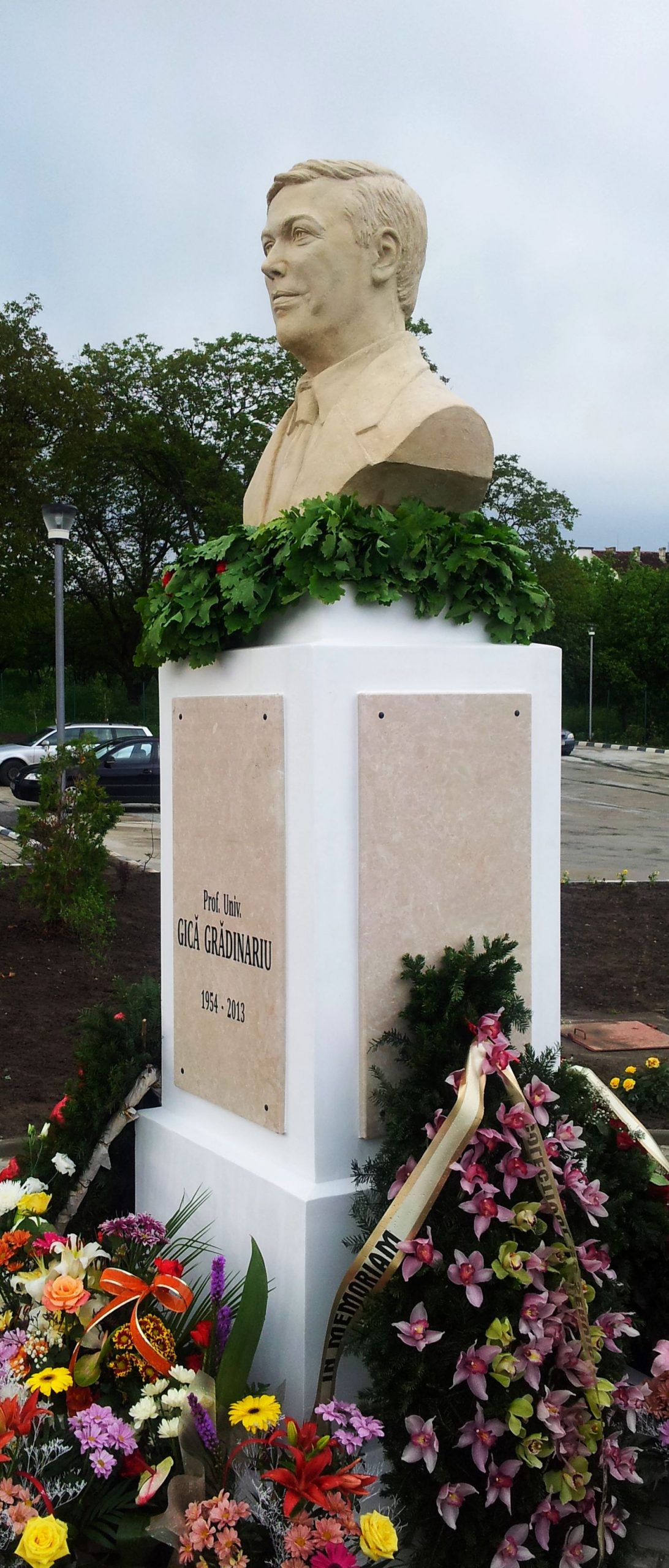
…Yes, reconciliation, peace, hope have returned! On May 17, 2014, in Pomârla, Botoșani! The place where university professor Gică Grădinariu went to school, near the village of Corjăuți, where he was born on May 18, 1954… A superb place, a wonderful place (about which Gică used to tell me so many times how will be…). Here, in a small park, with many flowers and shrubs, with the old walnut trees that the professor had loved so much ever since he was a student passionate about horticulture, in the presence of a large audience—students, university students, academics, officials, his dear family—a splendid open-air amphitheater was inaugurated. A miraculous place (which bears his name), where, as a mark of appreciation for all he had done in his life, the family, the local community, the city hall, and the prefecture had erected an exceptional monument… The unleashing came at the moment when I was on stage, trying to summarize, before a full amphitheater, a few thoughts about Professor Grădinariu, reproaching myself in the process for the time, effort, and energy Gică had spent over the years in which we had carried out together various academic evaluation activities across the country, university administrative work, or research… If the weather had been exceptionally beautiful that morning, it seemed as though, all of a sudden, after it had quickly turned overcast just a little while before, immediately after I had started to speak, a heavy, loud summer rain began to fall. The large, swift drops shattered rapidly against the pavement, scattering into small droplets… Under the sun’s rays, half-hidden by the low, threatening clouds, the scattered raindrops sparkled like fireworks… A murmur arose; the people in the amphitheater tried to find an umbrella or a raincoat to protect themselves; some ran onto the stage, to the shelter of the amphitheater’s roof… Suddenly, just as it had started, the rain stopped, the sun emerged from behind the clouds, its brilliance amplifying the colors and flooding the small park with a powerful light. From the stage, full of witnesses to this beautiful event, preparing to continue my short address, my gaze turned toward the monument consecrated by priests a few moments before. The white pedestal reflected the rays of light powerfully, blindingly, and the statue—the professor’s bust—stood serenely silhouetted against a sky of intense, infinite blue, yet with white clouds, close to the ground, puffy, playful, friendly… I again had the mixed sensation of a ‘déjà-vu‘ with the uniqueness of moments extremely rare in life… Of unique moments that remain with us forever in memory, that brighten our lives… The professor’s face shone in the sun, he seemed so at peace, content, happy… He was smiling at me and seemed to be telling me, with an unspoken meaning: … ‘Come on, let it go…, everything will be fine’…
How poor is life without such a friend… And yet, how beautiful life can be with just the memory of such a person, of the moments spent together, of the discussions and sharing of ideas, thoughts, aspirations, achievements…, or of ‘what is to come‘… Of the fact that life is so ephemeral, that we lose the most beautiful moments in life without realizing their uniqueness, that they are unrepeatable… I am convinced that, just as for Jorge Luis Borges, the verse “With time you will learn that trying to forgive or ask for forgiveness, to say that you love, to say that you miss, to say that you need, to say that you want to be friends, before a grave, no longer has any meaning” was also an axiom for Professor Gică Grădinariu. Perhaps that is why he knew how to live his life intensely, learning, working, building, passing on knowledge, going through life without fear, with confidence (“at my funeral, sing me ‘Christ is risen from the dead'”), without wanting to leave behind regrets, loving and forgiving as long as he lived, burning like a flame, like the most beautiful fireworks, leaving behind friends, imperishable memories, dear people, generations of young people and minds shaped by his spirit…
On the stage of the amphitheater in the park that bears his name, I no longer had regrets, I no longer thought that life is sometimes so unfair, that perhaps Professor Gică Grădinariu could have done so many more things in life, that… No, I only realized that he had given so much… I was convinced that he had smiled at me from ‘the other side’, that he was at peace with everything he had done in life, that he had also given me a part of his time and his power of love and friendship. I was convinced that through that statue his spirit will endure beyond times and places, will inspire and be a model for other generations of children, of young people… His monument in Pomârla, just like the grave in Galata and the office at the university, will be places of remembrance, points of reference for those close to him, places of pilgrimage for his family and descendants, for friends, for those he shaped, for those he loved and who loved him, and in whose memories Professor Gică Grădinariu will continue to live beautifully…
Cluj-Napoca, August 2014
Prof. dr. Radu E. SESTRAȘ
Prof. univ. dr. Gică Grădinariu
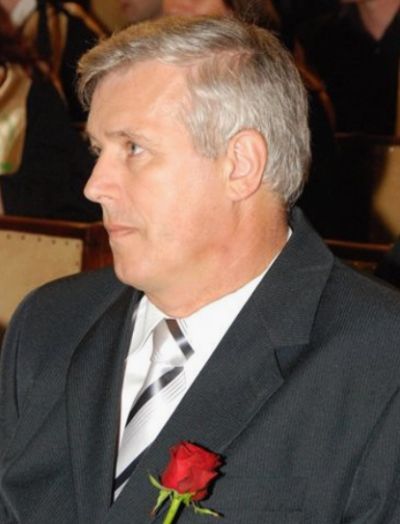
28 October 2013. Following a traffic accident, Prof. univ. dr. Gică Grădinariu, dean of the Faculty of Horticulture in Iași, passes into eternity… The teaching staff and students of the Faculty of Horticulture in Cluj-Napoca deeply regretted the ‘departure‘ (far too early…) of the renowned professor, an illustrious personality of Romanian horticulture.
The name of Professor Gică Grădinariu seemed almost predestined for horticulture… Through him, Iași horticulture offered Romanian horticulture a luminous figure, who will remain inscribed in the gallery of great scientists of our country. Recognized in Romanian pomology as a specialist of the greatest caliber, but also as a teacher from the category of ‘symbolic mentors’ who remain immortal in the consciousness of the generations of pupils and students he trained. A professor who loved, supported, and unconditionally promoted Romanian horticulture, merging with it, who left his mark on its history in recent decades, trying to break through into the light through the maze of bureaucracy, the ‘system’, the ‘structures’, the groundlessness of the times, dilettantism, the insincerity and hypocrisy of some… A man who dedicated himself to his profession, to work, ready at any time to sacrifice his energy, time, and health to contribute to science, research, the progress of knowledge in horticulture, academic development, and the training and education of young generations, both professionally and intellectually and spiritually… The Faculty, the university, as well as academic Iași could not have had a better representative… With how much affection we called him ‘Dean of Romanian Horticulture, ‘Dean of Deans, or ‘the Platinum Dean‘… With how much friendship, admiration, and respect these designations were accepted by all the top representatives of the academic community in the field in the country… As dean, Professor Grădinariu managed not only to build an exceptional image of the Faculty of Horticulture in Iași, but to build professional, scientific, but also collaboration and friendship relationships, unprecedented, with members of the relevant faculties in Cluj-Napoca, Bucharest, Timișoara, Craiova… In Cluj, the professor was exceptionally well-known and loved, enjoying a special consideration…” (Prof. dr. Radu E. SESTRAȘ: ‘REMEMBER – PROF. GRĂDINARIU, The thoughts of a friend and his modest tribute to Professor Gică GRĂDINARIU’).
Prof. dr. Vasile VÎNTU (Rector, USAMV Iași) and Prof. dr. Radu SESTRAȘ (Dean, Faculty of Horticulture in Cluj-Napoca)
Tribute to Professor Gică GRĂDINARIU
Pomârla, Botoșani, 17 May 2014